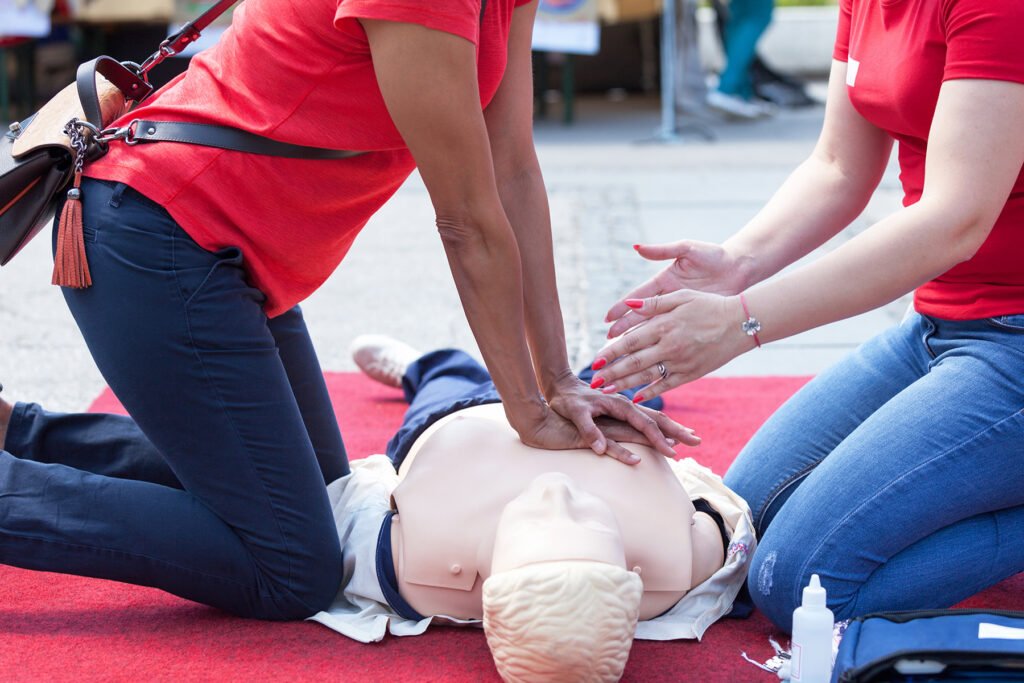
For many employers, the easiest way to train a team in CPR, AED use, and First Aid is to bring the class directly to the workplace. On-site group training can reduce travel, simplify scheduling, and let employees learn together in the environment where they may actually need to respond.

For Boston-area businesses, that can mean scheduling an instructor-led class at an office, medical or dental practice, school, gym, restaurant, warehouse, retail location, senior-care organization, or another workplace.
The most important planning step is choosing the right course before the training date. A general workplace CPR/AED course is not the same as BLS, and not every employer, regulator, school, or licensing organization accepts the same credential.
What Is On-Site CPR Training?
On-site CPR training is a group class delivered at the employer’s location rather than requiring each employee to travel to a separate public class.
The instructor teaches the applicable course, employees practice on training manikins and AED trainers, and participants complete the hands-on skills required by that curriculum. Depending on the course selected, First Aid topics may also be included.
For Saving Hands, current instructor-led CPR and BLS classes are completed in person. When a group class is arranged on-site, employees complete the applicable instruction, hands-on practice, and course requirements with an instructor at the scheduled location.
Why Businesses Choose Group CPR Training
On-site training can be especially useful when an employer needs several employees trained at the same time.
Common reasons include:
- Reducing employee travel time
- Training an entire department or shift together
- Keeping course selection consistent across the team
- Coordinating certification or renewal dates
- Minimizing disruption compared with sending employees to separate classes
- Practicing emergency response with coworkers who may actually respond together
- Building a more consistent workplace emergency-response plan
For businesses with multiple shifts or departments, training can also be organized around staffing needs rather than treating every employee as an individual registration.
Which Course Should a Business Choose?
The correct course depends on the workplace, the employees being trained, and the requirement the business is trying to satisfy.
CPR/AED for General Workplace Teams
For employees with limited or no medical training, an occupational CPR/AED course may be the appropriate choice.
The American Heart Association identifies Heartsaver CPR AED and Heartsaver First Aid CPR AED as workplace-oriented options for people who need a course-completion card for job, regulatory, or other requirements. AHA also notes that Heartsaver courses are available in classroom and blended formats.
The American Red Cross likewise offers workplace First Aid, CPR, and AED training for employees and organizations.
For teams whose requirements accept AHA Heartsaver, start with our AHA Heartsaver First Aid CPR AED course, then contact us to confirm group arrangements.
If your organization specifically requires Red Cross, review our Red Cross Adult and Pediatric First Aid/CPR/AED course.
BLS for Healthcare and Clinical Staff
If the group includes healthcare professionals or clinical staff, BLS may be required instead of standard workplace CPR.
BLS is designed for healthcare professionals and trained responders and typically includes adult, child, and infant CPR, AED use, ventilations, and multi-rescuer or team response.
A medical office, dental office, home-care clinical team, or other healthcare organization should not assume that a standard CPR/AED class will satisfy a BLS requirement.
For clinical teams whose requirements accept AHA BLS, review our AHA BLS Provider course and contact us about group training.
If your team specifically needs Red Cross BLS, use our separate Red Cross BLS course page. Follow your team’s written credential requirement.
First Aid in Addition to CPR/AED
Some employers need First Aid training in addition to CPR and AED skills.
That may be based on an employer’s own safety policy, an industry-specific rule, a licensing requirement, or another workplace standard. Before scheduling, the business should identify whether employees need CPR/AED only, First Aid/CPR/AED, BLS, pediatric content, or another course.
Does OSHA Require Every Employee to Be CPR Certified?
No. OSHA does not impose one universal rule requiring every employee at every workplace to hold CPR certification.
OSHA’s general industry first-aid standard, 29 CFR 1910.151, requires employers to ensure the ready availability of medical personnel for advice and consultation. It also states that when an infirmary, clinic, or hospital is not in near proximity to the workplace, one or more people must be adequately trained to render first aid.
That requirement is not the same as saying every employee must be CPR certified.
Other OSHA standards, industry-specific rules, state requirements, licensing rules, contracts, or employer policies may impose additional obligations. Businesses should identify which rule actually applies to their workplace instead of relying on a generic statement that “OSHA requires CPR.”
What Happens During an On-Site Group Class?
The exact class depends on the course selected, but an instructor-led workplace session generally includes explanation, demonstration, hands-on practice, feedback, and skills evaluation.
Employees may practice:
- Recognizing cardiac and breathing emergencies
- Activating emergency medical services
- High-quality chest compressions
- Rescue breaths where applicable
- AED use
- Choking response
- Adult, child, or infant CPR depending on the curriculum
- First Aid skills if included in the selected course
- Team response or multi-rescuer skills when applicable
Training manikins and AED trainers are used so employees can practice the physical skills without using real emergency equipment.
How Much Space Does a Business Need?
A conference room, training room, open office area, gym space, community room, or another cleared area may work depending on the number of participants.
Employees need enough room to kneel beside manikins, rotate between skills stations, and allow the instructor to observe and coach.
Before the class, the business should confirm the expected group size, room layout, access time, parking or loading considerations, and any building-security requirements with the training provider.
Planning the training time
There is no single universal class length.
Duration depends on the specific course, number of participants, equipment, discussion, remediation, optional modules, and whether First Aid or BLS content is included.
For example, AHA currently estimates an instructor-led Heartsaver First Aid CPR AED course at roughly 3.5 hours, while other course options and formats have different estimated times. AHA explicitly notes that actual timing varies with class size, equipment, discussion, remediation, and optional topics.
Businesses should use the scheduled duration for the actual Saving Hands course being booked rather than assuming every group CPR class takes the same amount of time.
Can Businesses Train Employees in Different Shifts?
Ask about scheduling options before committing to a date. Group training can be planned around workforce needs, subject to instructor availability and confirmation.
A company may choose to train one department at a time, divide employees into multiple sessions, or coordinate separate dates for different shifts.
The best structure depends on group size, operating hours, staffing requirements, and how many employees need the same credential.
If employees need different courses—for example, office staff need CPR/AED while clinical staff need BLS—it is usually better to separate them into the appropriate course rather than forcing one class to fit everyone.
How Long Are CPR Credentials Usually Valid?
AHA Heartsaver CPR/AED and First Aid CPR AED course-completion cards are generally valid for two years.
Red Cross CPR and workplace First Aid/CPR/AED certifications are also generally valid for two years after successful completion of the applicable certification course.
An employer may still choose to renew employees earlier so credentials do not lapse at different times or during a critical staffing period.
What Should a Business Verify Before Scheduling?
Before booking on-site CPR training, confirm:
- Which employees actually need training
- Whether the requirement is CPR/AED, First Aid/CPR/AED, BLS, pediatric training, or another course
- Whether AHA, Red Cross, or either organization is accepted
- Whether the employer or regulator requires an in-person skills component
- How many employees need the same credential
- Whether different departments need different courses
- The desired training date and time
- Available room space
- Any building access or parking instructions
- When employees’ current certifications expire
- Whether the business needs one session or multiple shifts
This planning prevents one of the most common problems in workplace training: scheduling a convenient class that does not actually match the credential employees need.
On-Site CPR Training in Greater Boston
For employers in Greater Boston, on-site training can simplify group scheduling. Confirm your location and the proposed training arrangements with Saving Hands before making plans.
Instead of coordinating separate registrations for each employee, a business can organize the training around its team, workplace, and schedule.
Saving Hands’ current instructor-led classes are completed in person, with hands-on practice and instructor guidance. Businesses arranging group training should confirm the exact course, number of participants, location, and scheduling needs before the class is finalized.
Request Group CPR Training for Your Business
If your team needs CPR, AED, First Aid, or BLS training, start by identifying the credential your workplace actually requires.
Then request a group training option that matches your employees, schedule, and location.
For Boston-area businesses, Saving Hands can help organize instructor-led, hands-on group training based on the course your organization needs.
Send the details for your group
Email info@savinghands.net or call (857) 332-1930 with your organization, training address, estimated headcount, required course and issuer, preferred dates, and current credential deadlines. Saving Hands will need to confirm the arrangements before the session is scheduled.
Planning AHA training? Review AHA BLS for healthcare teams or AHA Heartsaver for workplace First Aid, CPR, and AED training, then send us your group details. If you are unsure which issuer your organization accepts, read our AHA vs. Red Cross comparison and confirm the requirement before booking.